How to Choose the Right Industrial Automation System?
Choosing the right Industrial Automation system is rarely a matter of selecting the newest controller or fastest robot. It begins with the process itself. Walk through the plant. Watch where operators wait, adjust settings, or record data by hand. These details often reveal more than a polished supplier presentation.
Joseph Engelberger, a pioneer of industrial robotics, said, “The first step is to establish that something is possible; then probability will occur.” His point remains practical today. A suitable system must match production volume, product variation, maintenance skills, safety duties, and future expansion. It should also communicate reliably with existing PLCs, sensors, drives, MES platforms, and enterprise software. Small compatibility gaps can become expensive delays.
That sounds simple. Reality disagrees.
A responsible evaluation should compare total ownership costs, not only purchase prices. Include installation, training, spare parts, software licenses, energy use, downtime, and cybersecurity support. Ask vendors for documented performance data and clear service commitments. Check whether technicians can diagnose a fault at 2 a.m., when the warning light is flashing and production has stopped.
Standards and risk assessments matter. So do human judgment and site experience. I have seen technically impressive systems underperform because employees found them confusing or difficult to maintain. This is an uncomfortable lesson. The most advanced solution is not always the most suitable one. The strongest choice balances measurable efficiency with safe operation, dependable support, and realistic skills. This guide examines those decisions carefully, while acknowledging that every factory has constraints that a standard checklist may miss.
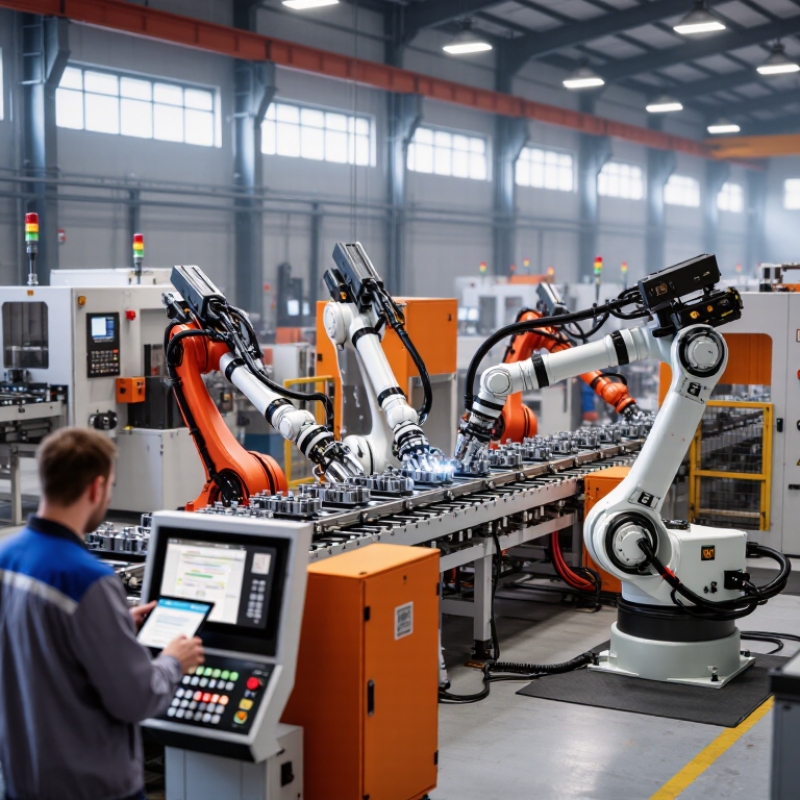
Define Production Needs with ISA-95’s Four-Level Automation Hierarchy
How to Choose the Right Industrial Automation System?
ISA-95’s four-level hierarchy helps translate production goals into practical technology choices. Level 0 covers the physical process, such as temperature, pressure, speed, and material movement. Level 1 connects sensors and actuators to capture or change those conditions. Level 2 manages machine control through programmable logic and supervisory systems. Level 3 coordinates production schedules, quality records, maintenance, and traceability. Level 4 links operations with business planning, inventory, and customer demand.
The boundary is often messy. A strong system should still keep responsibilities visible. According to the International Federation of Robotics’ World Robotics 2024 report, 541,302 industrial robots were installed globally in 2023, a 10% increase from 2022. More equipment does not automatically create better production. Engineers should map each signal, decision, and response before purchasing hardware. A useful test is simple: can an operator trace a defect from the product back to its control action?
Deloitte’s 2024 Smart Manufacturing and Operations Survey found that 86% of manufacturing executives expect smart manufacturing to become a primary competitiveness driver within three years. That expectation can encourage rushed investment. Begin with the weakest ISA-95 level, not the most impressive dashboard. Measure cycle time, unplanned downtime, energy use, and rejected units. Then define the required data flow between levels. This approach may feel slower. It is also easier to audit, maintain, and improve when production conditions change.
Set OEE Targets Against the 85% World-Class Manufacturing Benchmark
How to Choose the Right Industrial Automation System?
Set OEE Targets Against the 85% World-Class Manufacturing Benchmark
Choosing an industrial automation system should begin with measurable production needs, not impressive features. The 85% OEE benchmark offers a useful reference for world-class manufacturing. It does not fit every factory equally.
OEE combines availability, performance, and quality. Measure each factor separately before setting a target. Use machine logs, maintenance records, quality reports, and operator observations. A packaging line may lose eight percent through changeovers, another six percent through minor stops, and more through rejected units. Small details matter.
Set a staged target instead of demanding 85% immediately. A new line may begin at 65% while teams correct sensor faults and unstable cycle times. Review the data weekly, preferably with production, maintenance, and quality engineers together. Keep an audit trail for every calculation. It builds trust.
The benchmark can expose weak assumptions. An 85% result may hide rushed inspections or incomplete downtime records. That needs attention. A lower target may be more honest during product launches, frequent changeovers, or strict quality trials. The right system should make losses visible, support consistent measurement, and allow engineers to test improvements safely. Even experienced teams misclassify downtime sometimes. Recheck the definitions.
How to Choose the Right Industrial Automation System?
Set OEE Targets Against the 85% World-Class Manufacturing Benchmark
The commonly used world-class OEE benchmark is 85%, supported by target levels of 90% availability,
95% performance, and 99.9% quality. OEE is calculated as Availability × Performance × Quality;
these component targets produce an OEE of approximately 85.4%. Use these benchmarks to evaluate
whether an automation system can deliver stable uptime, speed, and defect control.
Specify Functional Safety Using IEC 61508 SIL Levels 1 Through 4
How to Choose the Right Industrial Automation System?
Specify Functional Safety Using IEC 61508 SIL Levels 1 Through 4
Choosing an industrial automation system begins with identifying credible hazards, not counting sensors or controllers. IEC 61508 defines Safety Integrity Levels from SIL 1 to SIL 4. SIL 1 offers the lowest risk reduction. SIL 4 demands the highest level and applies only to exceptionally serious risks. The required level comes from a documented hazard and risk assessment. It should never be selected because a system appears advanced.
A practical assessment examines the safety function itself. For example, a high-temperature trip may shut a heater within two seconds. Engineers then evaluate the probability of dangerous failure, response time, operating mode, and test intervals. Demand mode commonly uses PFDavg, while continuous operation uses PFH. Hardware fault tolerance and diagnostic coverage also affect the design. A higher SIL is not automatically safer if maintenance teams cannot test it correctly.
Details matter.
Specify sensors, logic solvers, and final elements as one safety function. Record assumptions, independence requirements, proof-test procedures, and bypass controls. Independent review strengthens reliability, especially before commissioning. One common mistake is treating SIL as a product label. It is a claim about achieved risk reduction within a complete lifecycle. A spreadsheet may suggest SIL 2, yet overlooked valve sticking can invalidate the result. That uncomfortable gap deserves investigation. Reassess the function after process changes, software updates, or altered maintenance routines. Worker training and clear fault responses remain essential, even in highly automated plants.
How to Choose the Right Industrial Automation System? - Specify Functional Safety Using IEC 61508 SIL Levels 1 Through 4
IEC 61508 Safety Integrity Level Comparison for Industrial Automation Functions
| SIL Level |
Low-Demand Target
PFDavg |
High-Demand or Continuous Target
PFH |
Approximate Risk Reduction Factor |
Typical Safety Application Context |
Selection Considerations |
| SIL 1 |
≥ 10−2 to < 10−1 |
≥ 10−7 to < 10−6 per hour |
10 to < 100 |
Lower-risk hazards where a dangerous failure could cause limited injury or localized equipment damage. |
Confirm that the risk assessment identifies SIL 1 as sufficient. Use suitable diagnostics, proof testing, and documented operating procedures. |
| SIL 2 |
≥ 10−3 to < 10−2 |
≥ 10−8 to < 10−7 per hour |
100 to < 1,000 |
Common for significant machine hazards, hazardous motion, pressure systems, and process functions requiring reliable shutdown. |
Evaluate the complete safety function, including sensors, logic solver, final elements, diagnostics, common-cause failures, and test intervals. |
| SIL 3 |
≥ 10−4 to < 10−3 |
≥ 10−9 to < 10−8 per hour |
1,000 to < 10,000 |
High-consequence hazards that may cause serious injury, multiple injuries, or major process safety events. |
Require rigorous verification, stronger independence and diagnostics, controlled change management, and evidence of systematic safety capability. |
| SIL 4 |
≥ 10−5 to < 10−4 |
≥ 10−10 to < 10−9 per hour |
10,000 to < 100,000 |
Extremely high-consequence hazards where a dangerous failure could result in catastrophic outcomes. |
Use only when justified by formal hazard and risk analysis. Expect highly robust architectures, extensive verification, and strict lifecycle controls. |
| System Selection Dimension |
What to Verify Before Choosing the Automation System |
| Required safety integrity |
Derive the target SIL from a documented hazard and risk assessment; do not select a SIL solely from the control system’s marketing specification. |
| Demand mode |
Classify the safety function as low demand or high demand/continuous, because IEC 61508 uses PFDavg for low-demand operation and PFH for high-demand or continuous operation. |
| Complete safety function |
Assess the complete loop: input devices, logic solver, communication paths where applicable, output devices, actuators, utilities, and the final safe state. |
| Proof-test interval |
Check how proof-test frequency, test coverage, repair time, and operational constraints affect the calculated PFDavg. |
| Hardware architecture |
Verify hardware fault tolerance, safe failure fraction, diagnostic coverage, independence, and common-cause failure controls against the applicable IEC 61508 requirements. |
| Systematic capability |
Review lifecycle processes for requirements management, software development, validation, configuration control, competence, maintenance, and functional safety assessment. |
Note: SIL values define target ranges for the probability of dangerous failure of a safety function. They are not direct ratings of overall production performance, cybersecurity, or machine productivity. Final SIL determination requires application-specific hazard analysis and verification.





 Daniel.Ding
 Ding
Ding