


 Daniel.Ding
 Ding
Ding

Why stepper motor is better than servo motor?
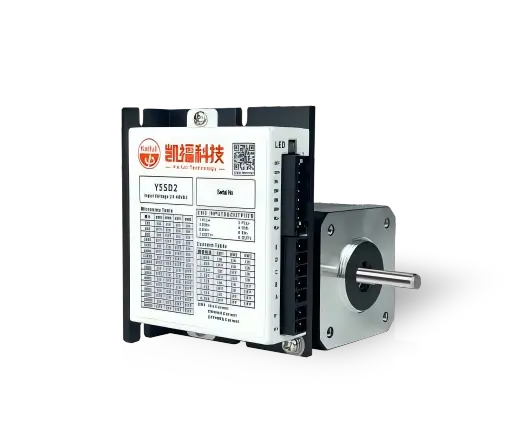
Stepper motors and servo motors are two popular choices in Motion Control systems, each with its strengths. However, stepper motors are often favored in specific applications due to their simplicity, cost-effectiveness, and precision in low-speed scenarios. In this article, we explore why stepper motors may be better than servo motors in certain applications.
1. Simplicity and Ease of Use
Stepper Motor:
- Stepper motors operate in an Open-Loop Control system, meaning they do not require feedback mechanisms like encoders or sensors to monitor position or speed.
- They are straightforward to set up, requiring only a stepper driver to control movements.
Servo Motor:
- Servo motors rely on a closed-loop control system, which necessitates encoders, feedback circuits, and more complex controllers.
- The additional components make servo motors more complicated to install and maintain.
For applications where simplicity is key, such as DIY projects or small-scale automation, stepper motors are more user-friendly.
2. Cost-Effectiveness
Stepper Motor:
- Generally less expensive due to their simpler construction and lack of feedback components.
- Lower initial investment makes stepper motors a popular choice for budget-conscious projects.
Servo Motor:
- Higher cost due to additional components like encoders, advanced drivers, and the motor’s complex construction.
For projects with budget constraints, stepper motors are the preferred choice.
3. High Torque at Low Speeds
Stepper Motor:
- Delivers consistent and high torque at low speeds, making it ideal for applications requiring precise control over small movements.
- Does not require gearboxes to achieve high torque in low-speed scenarios.
Servo Motor:
- Designed for high-speed applications but requires gear reduction to maintain torque at low speeds.
For applications such as 3D printing or CNC machines where low-speed torque is essential, stepper motors outperform servo motors.
4. Precision and Repeatability
Stepper Motor:
- Moves in fixed step increments (e.g., 1.8° per step), allowing for precise and repeatable movements without feedback.
- Well-suited for applications like robotics, 3D printing, and medical devices, where accuracy is vital.
Servo Motor:
- Offers high precision but requires continuous feedback for accurate positioning, increasing system complexity.
For projects prioritizing simplicity and repeatability over extreme precision, stepper motors are the better option.
5. Reliability and Maintenance
Stepper Motor:
- With fewer components and no feedback mechanisms, stepper motors are highly reliable and require minimal maintenance.
- Operates effectively in environments with less stringent performance demands.
Servo Motor:
- Due to the reliance on feedback systems, servo motors are more susceptible to wear and require regular maintenance.
For low-maintenance, long-term use, stepper motors offer a clear advantage.
6. Applications Where Stepper Motors Excel
Ideal Uses for Stepper Motors:
- 3D Printers: Precise layering and movement.
- CNC Machines: Controlled cutting and milling.
- Robotics: Accurate and repeatable positioning.
- Medical Devices: Precision in equipment like syringe pumps.
While servo motors are better suited for high-speed, high-power tasks, stepper motors dominate low-speed, high-precision applications.
Conclusion
Stepper motors are better than servo motors in applications requiring simplicity, cost-effectiveness, high torque at low speeds, and reliable precision. They are the ideal choice for small-scale automation, DIY projects, and industries like robotics, 3D printing, and medical technology. By understanding the strengths of stepper motors, you can choose the best solution for your motion control needs.