What is a Stepper System and How Does it Work?
A Stepper System is an essential component in modern machinery. It's used for precise control of movement. These systems translate electrical pulses into precise mechanical steps. Engineers and hobbyists alike appreciate their accuracy and reliability.
Understanding how a Stepper System works can be complex. Each step of movement is tightly controlled. This ensures that the machinery performs as expected. However, many users encounter challenges. Some may struggle with calibrating the system. There can be moments of frustration and confusion.
The versatility of a Stepper System is remarkable. It finds applications in robotics, 3D printers, and CNC machines. Yet, its complexity can lead to mistakes. Users must learn to hone their skills for effective use. Such a learning process can lead to improvement and innovation. Ultimately, mastering a Stepper System opens doors to countless possibilities.
What is a Stepper System: Definition and Overview
A stepper system is used to control motion with precision. It consists of a stepper motor and a drive mechanism. The motor converts electrical pulses into discrete rotational movements. Each pulse moves the motor a fixed angle. This allows for exact positioning without the need for feedback systems.
The fundamental principle of a stepper system lies in its ability to divide a full rotation into numerous steps. For instance, a motor with 200 steps means each pulse results in a 1.8-degree rotation. This can be both a strength and a limitation. Precision is advantageous, but errors can accumulate over time. Therefore, regular calibration is advised.
While stepper systems are versatile, they do have drawbacks. They tend to lose torque at higher speeds. This makes them less effective for rapid movements. Additionally, holding torque can cause the motor to overheat. Keeping these factors in mind is crucial. Understanding their operational range can help improve performance. This system finds applications in 3D printers, CNC machines, and robotics, allowing users to achieve detailed movements in various projects.
Key Components of a Stepper System: Motors and Control Units
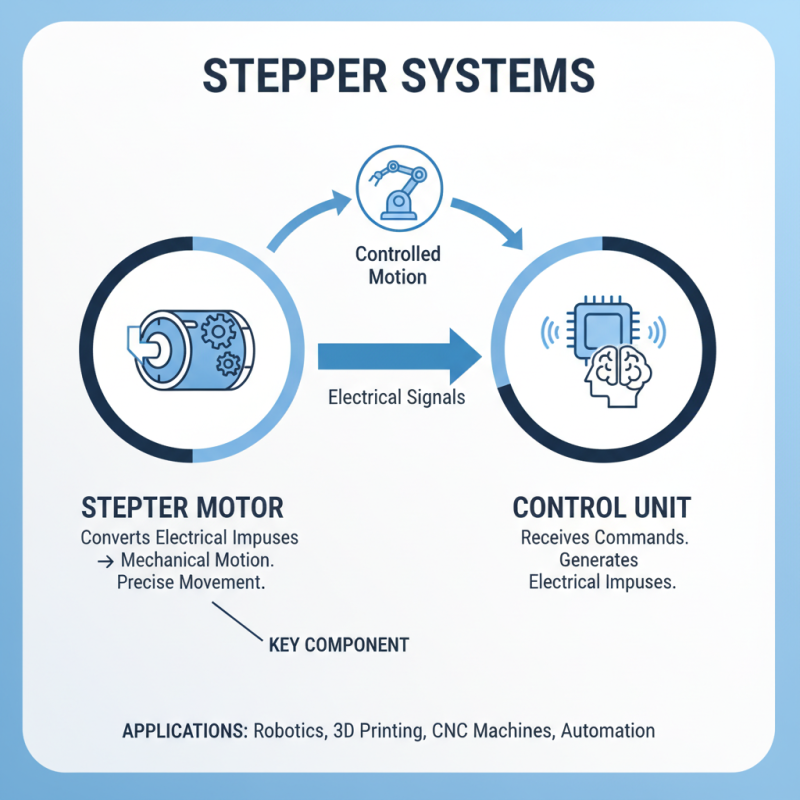
Stepper systems are widely used in various applications. They rely on two key components: motors and control units. The motor is the heart of the stepper system. It converts electrical impulses into mechanical motion. This allows for precise control over movement.
The control unit plays a crucial role, too. It sends signals to the stepper motor, determining how far and fast it moves. This unit can be simple or complex, depending on the application. It interprets the input commands and translates them into movement.
It's essential to recognize potential issues. Not all motors will perform well in every scenario. Sometimes, the control unit may fail to deliver the expected results. Regular maintenance can be beneficial. Users must remain aware of the system's limitations. Proper adjustments and calibrations can enhance performance, but they require ongoing attention.
Operating Principles of Stepper Systems: How They Achieve Precision
Stepper systems operate on a simple yet effective principle. They convert electrical pulses into precise mechanical movement. Each pulse delivers a fixed rotation, allowing for exact positioning. This method is highly beneficial in applications requiring accuracy, such as robotics and CNC machines. The ability to control movement to minute increments is crucial in these settings.
Precision in stepper systems comes from their design. A stepper motor rotates in defined steps, each corresponding to a specific angle. This ensures minimal overshoot and better reliability in positioning tasks. However, achieving optimal precision can be challenging. Factors like load, temperature changes, and motor wear may affect performance. Regular checks can help maintain accuracy.
Tips: Regular maintenance of your stepper system is vital. Check for any signs of wear or unusual noises. It can prevent bigger issues down the line. Also, consider the environment where your system operates. Dust and humidity can play significant roles in efficiency. Keeping it clean may enhance longevity and performance.
Applications of Stepper Systems in Industry: From Robotics to CNC Machines
Stepper systems have become essential tools in numerous industries. Their precision and reliability make them perfect for applications such as robotics and CNC machines. In robotics, stepper systems allow for precise control of movements, enabling robots to perform tasks like packaging, assembly, and even surgery. Each movement is carefully calculated, resulting in efficient operations.
In CNC machines, stepper systems play a vital role. They control the motion of cutting tools with high accuracy. This control ensures that materials are shaped to exact specifications. However, there can be challenges. Sometimes, misalignment occurs due to mechanical wear or incorrect settings. These mistakes can lead to wasted materials and time.
Despite these issues, the advantages of stepper systems are significant. Their ability to maintain consistent positioning is crucial in high-stakes environments. Industries rely heavily on this technology, recognizing its potential while also addressing its limitations. Continuous refinement in these systems helps to mitigate issues, advancing their applications in the future.
Advantages of Stepper Systems: Accuracy, Reliability, and Cost-Effectiveness
Stepper systems are gaining popularity in various applications due to their numerous advantages. One of their key benefits is accuracy. Research shows that stepper motors can achieve positional accuracy of up to 1.8 degrees per step. This precision is crucial in industries like robotics and manufacturing, where exact movements are necessary. Additionally, they offer high reliability. With fewer moving parts, stepper systems often experience lower maintenance needs and longer lifespans.
Cost-effectiveness is another significant advantage of stepper systems. Reports indicate that stepper motors often have lower initial costs compared to other motor types. This affordability makes them a popular choice for small businesses and startups. However, while they may seem more budget-friendly, the long-term operational costs can vary based on application demands. Users must assess specific use cases to ensure sustainable benefits.
Tip: When selecting a stepper system, consider the load and application requirements. This can help in identifying the right motor type.
Moreover, keep in mind that stepper systems may face limitations in high-speed applications. They might lose steps or torque under such conditions. Testing in real-world scenarios is essential for proper assessment.
Tip: Always evaluate the environment and potential loads, as these factors can influence performance significantly.
Stepper System Performance Metrics
This bar chart represents the performance metrics of Stepper Systems, including their accuracy, reliability, and cost-effectiveness. Accuracy is measured as a percentage of correct outputs, reliability indicates the system's uptime percentage, and cost-effectiveness is represented in terms of cost per unit produced.



 Daniel.Ding
 Ding
Ding